
Sigma (Σ or σ) is a term with diverse meanings across fields such as mathematics, statistics, physics, engineering, and even linguistics. Here’s an overview of sigma’s various uses and applications:
1. Mathematics and Summation Notation

2. Statistics and Standard Deviation
- In statistics, sigma (σ) represents the standard deviation of a dataset, which measures the spread or dispersion of data points around the mean. A low sigma indicates that data points are close to the mean, while a high sigma suggests they are more spread out. Sigma is foundational in statistical analysis and quality control, including Six Sigma, a methodology for reducing variation and improving processes in manufacturing and business.
3. Physics and Engineering
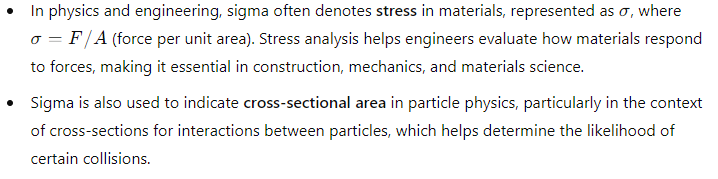
4. Chemistry
- Sigma bonds (σ bonds) are a type of covalent bond in chemistry, where two atoms share electrons directly between their nuclei. Sigma bonds are single bonds, strong, and fundamental in organic chemistry, forming the primary bond in most molecules.
5. Business and Quality Control (Six Sigma)
- Six Sigma is a set of techniques and tools for process improvement, aiming to reduce defects in business processes to nearly zero (within 3.4 defects per million opportunities). This methodology is highly structured, using statistical methods to improve quality and consistency in manufacturing, services, and business operations.
6. Linguistics
- In linguistics, sigma (σ) represents syllable structure. Syllables are fundamental building blocks of language, and sigma notation is often used in phonology to denote syllables within words.
7. Greek Alphabet and Symbolism
- Sigma (Σ or σ) is the 18th letter of the Greek alphabet and is often used as a variable in scientific equations and contexts. It symbolizes the sum or total of values, aligning with its summation role in mathematics.
Summary
Sigma (Σ or σ) is a multifaceted term symbolizing concepts from summation and variation in mathematics and statistics to stress and bonding in physics and chemistry. Its applications extend to process improvement in business with Six Sigma, while in linguistics, it helps denote syllable structure. Sigma’s versatility makes it a critical symbol for expressing sum, spread, strength, and structure across many fields.