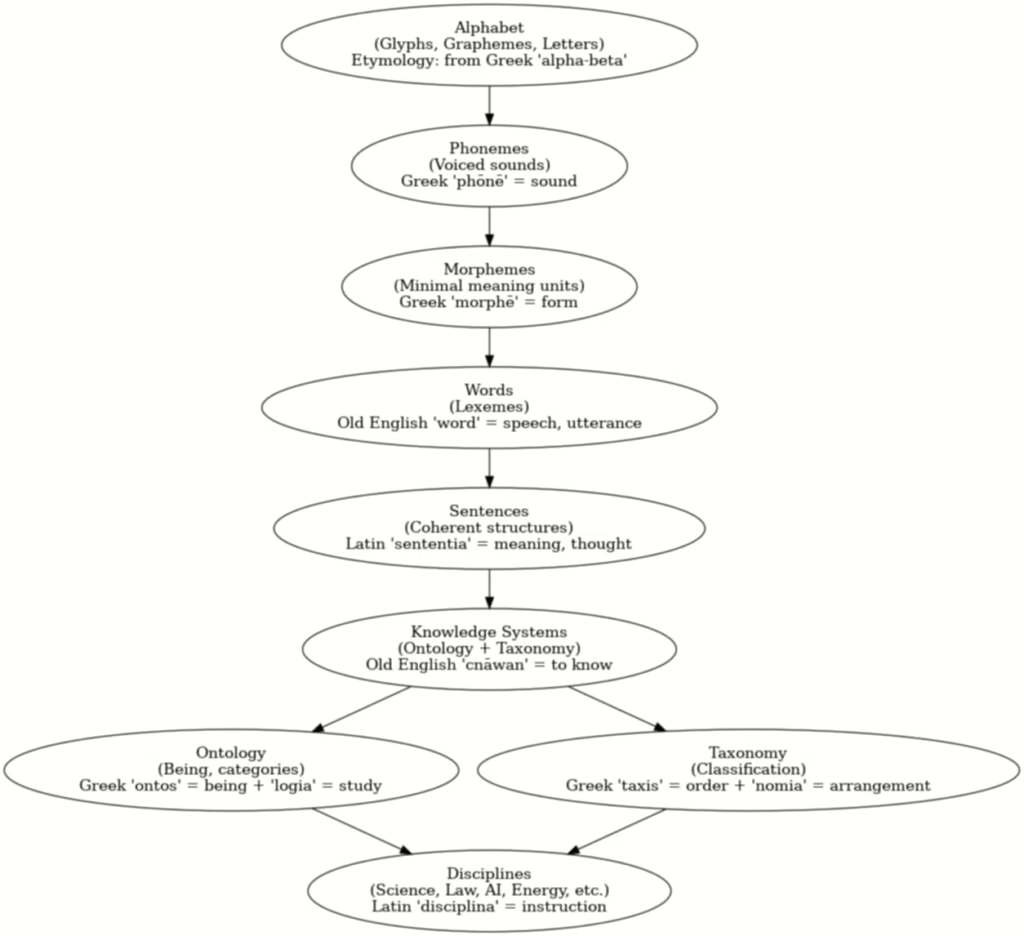
Definitions
- Language is the ordering of meaning expressed in units (graphemes, phonemes, morphemes, lexemes, syntax).
- Denial is an assertion of non-being expressed in language.
- Evidence is any communicable demonstration of truth, which requires language to be shared or understood.
Postulates
- To think is to order meaning.
- To order meaning is to employ language.
- To describe before, after, inside, or outside of time requires temporal terms.
- Temporal terms are linguistic.
- Every proposition—affirmation or denial—requires language.
Common Notions
- That which uses language presupposes language.
- Nothing can be proved or disproved except through language.
- The negation of language is self-contradictory, for negation is linguistic.
Proposition I.1
It is impossible to conceive the non-existence of language.
Proof.
Suppose language does not exist. Then to state “language does not exist” is itself a statement. But statements require language. Therefore the denial collapses into affirmation. Hence, language cannot not exist. Q.E.D.
Corollary I.1
All time-bound or time-transcending propositions (before time, after time, outside time) are only conceivable in language, therefore language is beyond temporal limitation.
Corollary I.2
Language is the eternal medium in which all thought, evidence, and existence are rendered meaningful.
✨ Restatement:
Language always exists. Every attempt to imagine otherwise already presupposes its existence.