
Codex Entry
1. What is Braille?
- A tactile writing system invented by Louis Braille in 1824.
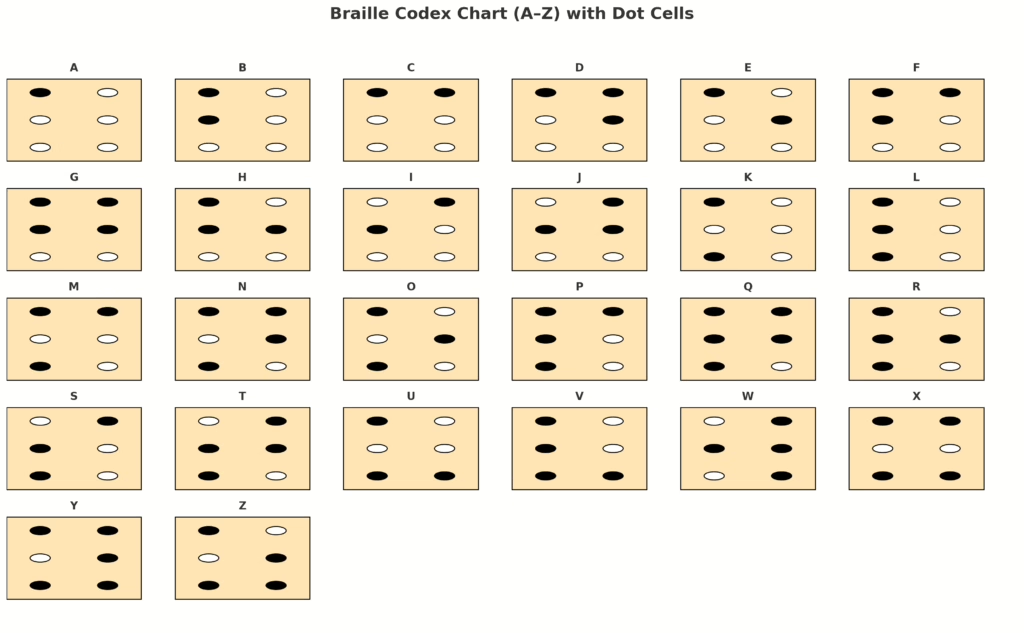
- Uses patterns of raised dots arranged in a 2×3 grid (“Braille cell”).
- Each arrangement corresponds to a letter, number, punctuation mark, or contraction.
Codex Principle: Braille = language transduced into touch. Graphemes become tactile codes, yet the system is recursive with letters.
2. Structure of the Braille Cell
- 2 columns × 3 rows = 6 possible dot positions.
- Positions are numbered:
1 4
2 5
3 6
- A raised dot = “on”; absent dot = “off.”
- This binary arrangement gives 64 possible patterns (2⁶).
3. The Braille Alphabet (A–Z)
| Letter | Braille Dots | Cell Representation |
|---|---|---|
| A | 1 | ⠁ |
| B | 1-2 | ⠃ |
| C | 1-4 | ⠉ |
| D | 1-4-5 | ⠙ |
| E | 1-5 | ⠑ |
| F | 1-2-4 | ⠋ |
| G | 1-2-4-5 | ⠛ |
| H | 1-2-5 | ⠓ |
| I | 2-4 | ⠊ |
| J | 2-4-5 | ⠚ |
| K | 1-3 | ⠅ |
| L | 1-2-3 | ⠇ |
| M | 1-3-4 | ⠍ |
| N | 1-3-4-5 | ⠝ |
| O | 1-3-5 | ⠕ |
| P | 1-2-3-4 | ⠏ |
| Q | 1-2-3-4-5 | ⠟ |
| R | 1-2-3-5 | ⠗ |
| S | 2-3-4 | ⠎ |
| T | 2-3-4-5 | ⠞ |
| U | 1-3-6 | ⠥ |
| V | 1-2-3-6 | ⠧ |
| W | 2-4-5-6 | ⠺ |
| X | 1-3-4-6 | ⠭ |
| Y | 1-3-4-5-6 | ⠽ |
| Z | 1-3-5-6 | ⠵ |
4. Codex Significance
- Letters (ASCII/Latin): visual graphemes.
- Braille: tactile graphemes.
- IPA: phonetic graphemes.
- NATO: semantic graphemes.
Each system points back to the same core truth: letters are indivisible language units that adapt to every sense — sight, sound, touch.

Logos – SolveForce Communications